08 March 2007

Crafts Organic Approach

Continuing the debate about craft and the digital - I came across this interesting book by Robert Frenay - Pulse: How Nature is inspiring the Technology of the 21st Century. What caught my eye was his suggestion that the new technology (and biology) will be "consciously crafted by humans" by bringing organic principles to all of human design. I quote "The machine age is about to meet a superior challenge. This doesn't mean the end of technology. There will be more of it now more than ever. But our best innovations will no longer be like those that sparked the industrial revolution. In the future they will increasingly be like living things. Not life in the traditional sense, but a biology that has been consciously crafted by humans - a new biology".

Included in this new technology are approaches such as haptics. One of the best examples of this being driven by craft is the Tacitus Project that explores the relationship of the applied arts to science and technology. Funded by the Arts & Humantities Research Council it has developed some Haptic Interfaces. "Haptics is the study of human touch and interaction with the external environment via touch. Haptic interfaces are a class of human computer interaction (HCI) devices that predominantly appeal to this particular sensory modality. Touch is unique as a human sense in that it can be used to gather information regarding the external environment and also to interact with it. " Anne Marie Shilitto is a jeweller and research fellow at Edinburgh College of Art and manager of the Tactitus project. This is another good example I feel of how craft is transforming the digital. For me crafts unique contribution to the digital is its organic approach.

I have argued that the philosophical origins of craft are founded on the organic principles of the German Romantics and Goethe in particular. See conference abstract on the New Craft: Future Voices Conference website. The full paper will be discussed at the conference itself in July 2007. Similarly Frenays book also discusses nature - "not as a place we visit or a focus of concern but as a system, a philosophy, a guide for our thinking and solutions in an increasingly complex world."

As an organic approach - craft is naturally slow, because it is grounded in relationship and connections and gradual improvements. Adopting an organic approach to the digital and technology also raises the importance of pattern, something that the crafts is particularly expert in. See for example the work of Frances Stevenson who works in printed textiles. Frances also attended the Radical Craft Conference in Pasadena last year - See last years blog. I will quote from that blog here to underline the point that craft is at the heart of the debates about making processes that are akin to living organisms.

"Our world was the subject of Constance Adams presentation,(she works for NASA) and I think her presentation was about as radical as you get. She presented 'Crafting the Mothership, space architecture'. She explained that Earth is ONE complex organism and in order for earth to survive the organism must propagate. If earth is the mothership then spacecrafts should be sent out to propagate other environments.This talk was great as it involved radical ideas in terms of how space exploration has forced 'makers' to rethink how they get something to work. She highlighted structures like soil, crystals and grains. Growing and living structures that are necessary for life. Structures that demonstrate the movement of life. What was really interesting is that she highlighted the need for natural methods and materials being used in order to sustain life, and how future visions look back to traditional roots. " This quote also connects with Jane Harris's discussion of the term craft in Mikes last post (see below) where she acknowledges that the term craft is being used in a process led way, such as 'crafting nano materials', to associate something that's so far ahead of us with something that's very past in order to realise it in the present.

This vision of organic craft would also include my own work (in partnership with Fraser Bruce at Dundee University) and colleagues in Edinburgh University and Professor Fraser Stoddart and his research group at UCLA looking at crafted approahces to Nano-technology.

What is also interesting about this is the link back to Bruce Sterling and his shaper/mechanistic short story series. These stories were concerned with a human genetic future and the ultimate commodification of humanity. The organics of craft and the organic principles of the 'new biology' shifts us away from the either or choice of the mechanists or the shapers but enables us to consider a future in which mechanistic technologies are incorporated within an organic approach.

So the 'new biology' as Frenay points out "... doesnt reject the machine age. It builds on it and incorporates that by stirring its classic logic into the larger complexities and dynamics of living systems." By acknowledging crafts organic principles we have much to contribute to this emerging future. It would be good to hear views on this and suggestions of other relevant organic craft examples.

06 March 2007

Slow design

Here at Craft Research we are pleased to share our thoughts and observations with a generally small but committed readership. And they are not all lonely weavers from Fife. Some live as far afield as Edinburgh. In fact, we have readers and comment contributors from throughout the world, and generally get around 30 hits per day. At one stage last week we were getting 30 hits every hour - and from places we don't normally get hits, like Harvard, Price Waterhouse and Microsoft. Weird, eh? The reason for this is that Bruce Sterling had quoted and linked us on his blog. He had referred to the admittedly rather provisional typology of digital craft practice I had put forward in the previous post, concluding his comment with: "Oh really? Do say more!".

I started to draft something in response, then read an article that fluently expressed what I was trying to say. The article is in Crafts, which is published by the UK Crafts Council. I've subscribed to this for a decade and a half, and in the last few years seriously wondered why. In the days when Peter Dormer strode its pages with his impassioned writing, Crafts raised debate and helped to gain a contemporary relevance for the crafts. But since his sad death, the publication appeared to slip ever closer to coffee table anonymity. Now, with a new editor, refreshed look and some sparkier writing it has a welcome reinvigorated spring in its step. From being the Daily Telegraph of the applied arts, it's now more like the Sniffin' Glue of the connected crafts. With Caroline Roux at the helm, Crafts is on a far more interesting path.

In the latest issue Jane Harris and Timorous Beasties are in dialogue with Nick Barley, recently appointed as Director of The Lighthouse, Scotland's Centre of Design. The entire article is worth reading, but alas it is not online, so below I have included some excerpts that hopefully address Bruce Sterling's request for more on the relationship between crafts and the digital. JH is Jane Harris. PS is Paul Simmons. AM is Alistair Macaulay.

PS - It's interesting that even the name of the magazine we're going to be in - the dreaded 'craft' word - got such a bad rap in the 90s. But being at art school helped us learn about material, about process, about how to actually make something because after all, we've got to learn about that in order to design for it.
JH - It's a term I fought against during that time - ironically, there's now a new use for it, particularly in the context of emerging media. They're using it in a process led way, such as 'crafting nano materials', to associate something that's so far ahead of us with something that's very past in order to realise it in the present.
PS - Tom Dixon's a craft person, so is Marc Newson, Ron Arad; all these people started making things for themselves and having that knowledge of the materials.
AM - And that's what sets them apart, because they're totally involved.

There then follows a fascinating discussion which ends up focussing on why time and development and reflection are central to the craft process, and how this results in unique outcomes. Finally Jane says:

JH- I went to a wonderful presentation the other day by Gossypium who have spent the last 15 to 20 years working with cotton farmers in India, really going back to source. They have a shop where they sell basic clothing and it just walks off the shelves but everything's shipped in from India, and people can wait six months for a babygrow. It's an incredible concept: it's like slow food.

Slow design: that is craft's contribution to digital culture.

27 February 2007

Poets of (sometimes lost) interaction

Sandra's post below on Technocraft rang a few bells.....

The January issue of Icon ran a piece called Digital Poets by Daniel West describing how "A new generation of designers is moving beyond traditional product and furniture design, and using technology to enrich the way people interact with objects and spaces." Again, it was centred on ideas and graduates coming out of the RCA's Designing Interactions course led by Tony Dunne. As Dunne is quoted as saying in the article: “A materials-led approach to design is expanding to embrace digital technologies... New hybrids of design are emerging. People don’t fit in neat categories; they’re a mixture of artists, engineers, designers, thinkers. They’re in that fuzzy space and might be finding it quite tough, but the results are really exciting.”

The Icon and Wallpaper articles cover similar ground and cite some of the same practitioners. While few (if any) of them would define themselves as craftmakers, that is not really the point. What we have is evidence that craft thinking and processes are engaging with interaction design as a form of critical design. My only frustration is that design journalists seem to have immense difficulty in looking outside London and the RCA for evidence of exciting and relevant work in this field.

I have an interest in how craft makers are engaging with digital culture, but I'm not convinced that 'Technocraft' is really that appropriate as a label for them. I'm playing with definitions here, but let's see how this works...

iCraft. We have people like Justin Marshall and his colleagues in the Autonomatic group - excellent makers working at a post-doctoral level - who are exploring the integration of digital process into their workshop-based practice, and helping to define a digital craft aesthetic. Their mission is to "raise the profile of making in 21st century design culture". There is exploration of how the relationships between craft, industry and digital process can be redefined to create new physical possibilities.

HybridMakers. Then there are those who are bridging craft and new media, moving away - to varying degrees - from physical objects, but still using creative methods that are rooted in making and indeed champion making as a method. John Marshall (no relation) I would place in this camp (perhaps he disagrees), and Jane Harris most definitely is.

CraftInteractionists. These makers are using crafted objects and craft process to explore new possibilities of interaction design. Here we have examples such as Jayne Wallace, Hazel White (in collaboration with Ewan Steel) and Sarah Kettley. A number of the 'Technocraft' examples also fall into this category. Particularly interesting is the work of Ranjit Makkuni, an interaction designer formerly based at Xerox PARC, and who was this week the subject of a feature in Business Week. He is developing exciting work that uses artists and craftmakers to create innovative interactive environments. As he says in another recent interview:

"My recent work, the Crossing, is looking at new forms of hardware and mobile devices that unlock the symbols, spaces and interpretations of Banaras. This would be an example of a project in which there was multiple layers of design: from crafts, to metal work, to wood crafts, to paintings, to all the stuff that we do with embedded programming such as in situ embedded audio and graphics, to video, to graphic design, to multimedia design-all of this integrated to create very rich experiences."

Also, here at Dundee, Graham Pullin, formerly of IDEO, has done a great student project - The Museum of Lost Interactions - that cyberpunk guru Bruce Sterling described as: "this dead-media hoax 'museum exhibit' by these Scots design students is just the awesomest." While this is not interaction design by craft makers, it demonstrates the value of 'crafted' objects that that tell stories about interaction and culture.

Linking back to Andrew Wagner's point raised in this blog a few days back, craft has such immense diversity that we need to celebrate and revel in. And try to make sense of. It is fortunate that many of those working in these particular areas of craft practice will be at New Craft Future Voices this July. I look forward to what they have to say.

Technocraft

This months Wallpaper features an article entitled Technocraft - describing a new design movement featuring hi-tech, quirky one-offs.

"The technocraft movement is a European Art School take on the garage start-up culture of Silicon Valley. Typically based in shared studios and home offices, technocrafters know how to programme computers and lay out circuit boards. Yet they are not driven by Fordist dreams of mass production. Instead, with a soldering iron in one hand and a PowerBook in the other, they use technology to express their creativity. The products themselves are often deliberately chunky and retro-styled but there is poetry in the ideas."

The article concludes; "If technocraft is a movement, then it s a protest movement mixing art, design, physics lesson technology and a rough-hewn way with wit and materials. Most often home-made and one-off, technocraft exposes the false promise of the international gadget giants who bury technology in the bland design and peddle the myth of unstoppable, inevitable and technology driven progress."

I love the way the author has connected craft and poetry in making. Its also good to see craft once again being 'embedded within everyday life in new ways' as Mike puts it.

This is another 'exciting facet' to craft - more please.

26 February 2007

A Job for The Doctor?

The latest development in the Craft Wars is a fleet of crocheted daleks that have recently hoved into view, featured a couple of days ago on boingboing (American readers - many of you won't know what a dalek is, so a brief update here). Firm evidence, then, that the hobbyists have adopted serious weaponry in the battle to appropriate the concept of craft from the 'fine craft' communities.

Sandra Wilson's original post - both ends of the spectrum - and the comments that it stimulated have raised some important questions. For me, the most telling point raised by Sandra was this: "One end of craft has for some time been keen to distance itself from the term and yet the other end is happy to embrace it and reinvigorate it for a new generation". One reaction to The Guardian's championing of the craft hobbyists - according to one comment made on our blog - is to "find a new word for hand making.... (because) craft just doesn't do it". Talking to other professional makers recently suggests that this view is widespread. In other words, give the hobbyists 'craft' and we'll adopt something else.

Great idea. We have thousands of people worldwide who are getting passionate and involved in craft, we have national newspapers devoting special supplements to it, we have a whole new culture emerging that is embedding craft within everyday life in new ways and often weaving this into radical politics. What better than to turn our backs on this movement, and the opportunities that it presents us with, and retreat into a little world of our own making?

We also have the design industry looking seriously at craft as a source of innovation and underlying philosophy for design practice in a post-industrial age. Last year's Radical Craft conference attracted over 800 people to Art Center Pasadena - one of whom was our own Frances Stevenson who blogged here about it.

A recent comment on our blog made by Andrew Wagner, the new editor of American Craft magazine, argues: "There are so many facets to 'craft' which is precisely what makes it such an exciting, vital, and absolutely alive and kicking field but it is so rarely shown this way...it is always one way or the other and that is where I see the mistakes being made. I think 'craft' needs to proudly display the ranges of the discipline and revel in those."

My frustration for some years is that craft has failed to make a case for itself, and has failed to connect with the wider culture. As a result it becomes ever more exclusive, culturally disconnected and seemingly inarticulate. Our project (along with others such as Sandra Alfoldy's at NSCAD) is seeking to overcome some of the problems by encouraging and enabling a research community to move necessary debates forward, but we clearly need to go further. We need more than academics to work on this - this is not simply a job for well meaning doctors of craft.

Craft practitioners, curators, journalists, hobbyists, designers (and yes, even academics) need to develop and extend dialogue. We need to define the common languages that Sandra is calling for. We need to find ways of not only celebrating diversity, but making more productive links between diverse practices. And we need to realise our common interests, and pursue them together. We need a new vision in the making.

19 February 2007

What is craft research?

As we canter up to the New Craft Future Voices event, we should begin to focus our thoughts and discussions on one key question in particular: what exactly is craft research? I say "one key question", but of course there are a number of related questions bound up in this. How do we define it? What is its scope? How do we articulate its wider value? Is it not simply a subset of design research?

I pose these questions because of the need to define a position in respect of both critics and those whom we seek to support and encourage. Two recent events have brought these questions into focus. One was the view expressed by a prominent member of the design research community to a colleague that (I risk paraphrasing here) "little of any significant value has arisen from research in the crafts". The other was a conversation with another colleague who was expressing frustration that she had to learn how to write as a social scientist in order to publish in the field of craft research, while such writing skirts around but does not get to the core of the original knowledge that was arising from her practice. Her view was that we have failed to define a way of communicating craft research that is appropriate to our disciplines. Twelve years ago I began to discuss this in a somewhat polemical piece It's Research, Jim... that I had intended to revisit at some point, but never got around to. It's probably time that I did.

We should aspire to define a field of inquiry with its own distinctive methods, forms of communication (and perhaps learned society?) that is sustainable and valued within the wider academic community. The response to the New Craft Future Voices call for papers is hugely encouraging. There is some excellent, engaging and committed research being undertaken in craft disciplines throughout the world, much of which does not readily find a home in existing research communities. Therefore we have an opportunity to define and create a framework for supporting such research.

So, my initial stab at a definition is this:

Craft research aims to improve the understanding of and enhance innovation within craft practices.

Its key objectives are to:
  • explore the cultural and economic value of craft
  • promote discourses around the nature of contemporary practices
  • develop appropriate means of communicating the craft knowledge that arises through practice
  • promote innovation in craft practice.
I welcome all contributions that seek to improve on this initial definition and move us further towards articulating a clear position on what is craft research.

04 February 2007

Both ends of the spectrum

The second in a series of monthly Guardian Guides is - Craft. It focuses on how to make everything from a stylish new dress to a DIY dining table. An interesting section entitled adventures in modern craft includes "New Wave Crafting" that derives pleasure from the recycling of everyday objects.

"More punk than Stepford homemaker, the modern craftster is a sociable creature, gathering in pubs, clubs and online to chat and swap ideas."

The guide also includes crafty websites we love - with one glaring omission!

This is a guide for those who wish to get in at the ground level of craft - this is the craft of the hobbyist. Craft sadly is not presented as a vocation or a worthwhile way of making a living - it is presented as a distraction from everyday living rather than a way of living.

http://lifeandhealth.guardian.co.uk/guides/craft/0,,1998461,00.html


This same week the Craft Council will be promoting Collect the leading international art fair for contemporary objects in London. This is what some might describe as the other end of the spectrum, forty one galleries presenting work by over 350 leading artists.

http://www.craftscouncil.org.uk/collect/


The word Craft here is only visible in the title of the Council but for how much longer? One end of craft has for some time been keen to distance itself from the term and yet the other end is happy to embrace it and reinvigorate it for a new generation.

Why are we so ashamed of our hobbyist associations? Do both not belong to the same family of craft? Are both ultimately just striving to understand what it means to be human? Some more dedicated than others? Can we not celebrate this diversity, rather than create more distance between us? How much of this distinction is related to class? Do these craft differences exist in other countries? Writing this blog on both ends of the spectrum has also made me ponder where is the craft middle ground, what does this look like and who occupies it?

23 January 2007

craft research

craft research
Title:
BeautyMy research is raising interesting questions, and there is one I’d like to share and discuss here: ‘Is the concept of beauty timeless and unchanging?’Looking at an example of historical craft practice, namely the ‘Vine Corridor’ (created in 1899, commissioned by the 3rd Marquis of Bute, and situated in the House of Falkland, Scotland), I’d like to explore the question by initially concentrating on the role of natural light and its relation to beauty.In the narrow ‘Vine Corridor’, natural light dances through three, small stain-glass domed windows. The three windows represent different parts of the day, namely ‘dawn’ ‘mid-day’ and ‘dusk’ and are coloured accordingly. For example, the morning window is coloured with cool, soft mauves, greys and blues, the midday window is golden with oranges, yellows and pale blues, and the early evening window has a rich, warm, palette with deep pink, red, purple and gold. The windows in themselves are aesthetically pleasing, quality pieces of craft. But, when natural light passes through the stain-glass and falls on the highly patterned and colourful ‘stucco’ plasterwork on the walls, the significance of the craft aesthetic is heightened. There is a new story being told, one that brings the natural cycle of day together with symbolism in the 'Vine Corridor'. When you walk through the corridor you realise beauty is a dynamic quality; it demands that the eye is constantly moving, challenging the eye's ability to stay focused on one element for a sustained period of time. This is one of my observations, but what are your observations of the role of natural light on craft practice? How does it affect your practice? Does it? Perhaps you would like to comment on another aspect?

05 January 2007

Exploring Contemporary Craft at the V & A

craft research

Found this informatiion about an event at the V & A in London in february that people may be interested in.

The Maker's Perspective: Exploring Contemporary Craft
Saturday 10 February 2007
10.30-16.15
Lecture Theatre

Contemporary crafts are expanding, with extremely talented artists working in the field and the number of galleries and collectors growing rapidly here and abroad. This study day examines contemporary craft practice and compliments COLLECT the international art fair for contemporary objects which is presented by the Crafts Council at the V&A from 8-12 February 2007.

Chaired by Amanda Fielding, Camberwell/V&A Fellow, the day will include four leading craft artists talking about their work and its development. Participants will have the opportunity to view COLLECT 2007, where they will see examples of some of the artworks discussed and the day will conclude with a question and answer session.

This event is aimed at a non-specialist with an enthusiastic interest in applied art and craft, as well as budding collectors who wish to inform the way they collect.

Programme

10.00: Museum opens

10.30: Welcome, Anne Fay, Learning and Interpretation, V&A

10.35: Introduction by Amanda Fielding, Camberwell/V&A Craft Fellow

10.45: Muddy Fingers
Ceramicist Daniel Fisher will speak about looking, playing and getting dirty.
Daniel Fisher, Ceramicist

11.30: Coffee

11.50: Half Truths and Recollections
Leading glass artist Bruno Romanelli takes a chronological journey through his work from leaving college to the present day.
Bruno Romanelli, Glassmaker

12.35: Lunch (not provided) and an opportunity to visit COLLECT

14.00: My Path through Metal
Ndidi Ekubia will describe how her fascination with metal began and how function plays an important part in the design and interpretation of her silverware. Using hand raising techniques she is able to push metal into fluid three-dimensional forms then manipulate the surface to create movement and vitality.
Ndidi Ekubia, Metalsmith

14.45: Tea

15.05: Material Evidence
Michael Brennand-Wood will be speaking about his current work and projects, making reference to the context and history of his recent practice and associated influences.
Michael Brennand-Wood, Textile Artist

15.50: Panel discussion and audience Q&A

16.15: Close and opportunity to visit COLLECT

Cost

£38 (including V&A Members and Patrons). Concessions: £32 senior citizens; £12 disabled people, ES40 holders and students. One free lecturer's ticket is offered for every 10 student tickets booked and one free place can be offered to a carer accompanying a disabled person. Ticket price includes morning coffee and afternoon tea. Tickets must be booked in advance online or by calling +44 (0)20 7942 2211 or emailing bookings.office@vam.ac.uk

11 December 2006

craft research

On the http://www.craftscotland.org/ A Hutcheson makes this comment. "I recently attended a talk at Dundee Contemporary Arts Centre in Dundee, where the three presenters, originally from either a jewellery or textile background, referred to crafts as the ‘c’ word, and apologised whenever the craft word appeared, in his/her presentation." What a sad inditement. Do we as craftspersons now not only have to find other names for ourselves to maintain credibility, but to apologise when we use the word CRAFT?
We should be standing up for ourselves: We should carry the name "Craftsperson" with dignity and pride: We should produce work worthy of the high standard and quality traditionally expected of a craftsperson. We should walk with our heads held high!

06 December 2006

A story of craft

I read a wisdom story, called product line.
1. There used to be an American trader arrived at a small town in Mexico. He met a craftsman there, who was making and selling delicate baskets, which only cost 2 cents. The trader bought one back to America. His friend saw the basket and was willing to buy it on the price of 1.75 dollars. Friend also wanted to buy as many as the trader could offer. The trader went back to Mexico immediately. He wanted to buy a great deal of baskets from the craftsman. But he got a rejection. The trader asked the craftsman why he refused such a big business. 2. The craftsman said: “look, I made the basket along my own thinking. Every morning, when the sun comes out, the birds start to sing, butterfly stop on my work. I knit the song and my soul into it. That is the reason why the butterfly can stop and I can make. If I made a lot of them, there won’t be a song, neither my soul, then every basket is the same. It will erode my heart.”

So what is your thinking about this story? Do you think the meaning come from the part 2? Such as the unique value in each craft process which distinct the hand making from machine producing?

As you may see, the thing annoyed me is why a delicate basket only sell 2 cents, especially when the craftsman knit his soul into it? Should he be angry with the price? What is the value of craft in market/economy?...

It is a story or not just a story…

24 November 2006

A Place for Creative Work

I have recently returned from a one day conference in London organised by EUCLID, (UK, European and International information and services for arts and culture) entitled: A Place for Creative Work: International Responses.

"Finding the right space to work as an artist or creative practitioner is still a challenge for many. This conference brings together people from Europe and the Americas who are involved in delivering particularly innovative and successful responses to this challenge." says the opening paragraph of the conference literature. This is what it did, and it was an eye opening experience for me to hear some of the projects that are taking place around the world.

Generally there was a lot of discussion about investment in people, not just buildings, and the need to create a human infrastructure as well as the bricks and mortar. There was debate about the need to shift the current paradigm so that creative people are recognised as valuable assets, not a luxury or a drain, and that there needs to be a global creative revolution! As I was listening to this I thought about all the shopping malls that are springing up in towns and cities and the increasing similarity between each of them. I thought about the planning departments who make the decisions about what facilities we 'need' that in essence define our very culture. It seems that we need to shop....all the time...in the same shops....everywhere. So I thought, who decides that we dont need a creative community to occupy areas within a city centre? Creative communities can regenerate areas, they can be a commercial resource as well as a tourist attraction. Shawn Patrick McLearen from Artspace USA (a non-profit real estate developer) sited exactly HOW WHAT WHY and WHERE, (which included figures) for all of us to gawp at with envy. According to Keith Hackett (a freelance consultant), the EU Lisbon vision is to nurture regional distictivness. Surely art and craft has a central role to play in this vision?

Tim Jones the Director of Artscape in Canada, another non-profit enterprise, talked about building creative communities, developing creative districts and clusters and cultivating creative cities. He believed that the way forward is to be pro-active and deepen the understanding about creativity. He was the person who said we needed a paradigm shift in order to develop a culture of creativity and innovation. People he said can change the world for the better.

The director of the Media Guild in Amsterdam, Andrew Bullen talked about the Guilds aims, which are to "stimulate the innovation potential of [the Guild] and multi media creative industries by bringing together, coaching and enabling talented starters, young entrepreneurs and established professionals to develop and prototype their ideas'. like the other speakers the space they inhabited is in a central location and was rescued from demolition. And like the others, there was nothing second rate about these spaces, they are contemporary workspaces for "creatives".

I just want to discuss one of the final speakers briefly, David Panton from ACME in London. He explained Barratt (the house builders) wanted to build apartments in a prime spot that, I think, had been targeted for business use. Barratt approached ACME and between them devised a way for Barratt to build a sister block that would be used as studio spaces. Their plan was accepted.

So if like Gus Casely -Howard (this months Crafts Magazine) you are fed up with "...craft not being as glamorous as fashion, or as marketable as design, or as credible as visual art [when] we all know that the craft market has a greater potential than the fine arts market , that more people want to buy craft than painting, that a greater proportion of the public want to participate in craft", we are going to have to give some thought to space, how we get some(much more than we have at present), and how we develop creative communities.....aren't we?

22 November 2006

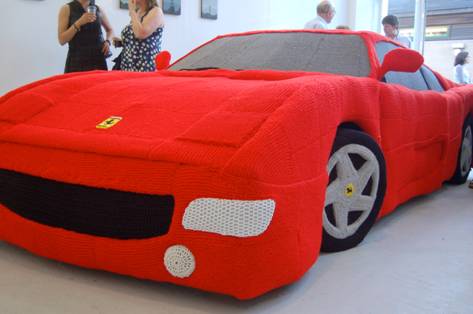
Knitted Ferrari


craft research
Just thought I would add this posting of a Knitted Ferrari that appeared on BBC breakfast news the other day. Any comments?

Lauren Porter’s Knitted Ferrari
Sarah Myerscough Fine Art
(Monday 27th November to Friday 1st December)


In Laurens Porter’s full size knitted Ferrari we find the fusion of the seemingly incompatible. The most aspirational of all consumer products is presented in the medium most quintessentially ‘home-spun’. The masculine is brought together with the feminine, soft with hard, young with old and the fast with the slow - this particular Ferrari was 10 months in production. If you were to ask what the opposite of Ferrari might be – could the answer be knitting?

The beauty of this piece is not just in the simplicity with which these associations and stereotypes are challenged; the positivitey with which Lauren raises these questions is just as immediate. Stressing the importance she places on using humour and optimism to put across a deeper meaning, Lauren especially wants people who don’t normally go to art galleries to see her work.

The wide appeal of this piece can be seen in the breath of interest in it - exhibited in both the British International Motor Show in the Sunday Times VIP Super Car Section and at the Alexandra Palace for the Stitch and Knit expo. ‘I get men admiring the racing lines and old women admiring the stitching’ Lauren says, and likes the way that people walk away from it with a smile on there face.

A controversial cross between a Testa Rossa and a 355, this version includes windscreen wipers, wing mirrors, low profile tires and, of course, the famous badge (here hand embroidered). Having already drawn a great deal of attention to itself, having been featured in the Times, the Sun and on BBC 1 already this year, the red knitted Ferrari will now be on sale at Sarah Myerscough Fine Art.

10 November 2006

craft research

There is an interesting discussion going on in the forum of the Craft Scotland website. http://www.craftscotland.org under "Craft in Crisis" posted by Tina. This was a recent comment by 'Duncan' "I think Liz and her question about who the credit goes to (the work or the maker) is a moot point. The work and the maker are related - but surely the work is the most important thing - many great works have been produced by not very nice people (!), but that does not make the work less important.Also, knowing what craft is and this encouraging people to come and see/buy craft is not a strong link. Perry won the Turner Prize (although avoided using the craft word) and Chihuly does 'glass sculpture'. These people avoided the craft word, and reaped the benefits, it could be argued. Potentially, had they used the craft word, they would not be where they are now. I still think this hangup on names is becoming irrelevent. On fewer people going to craft shows - correct. But fewer people go to installation shows in visual art, fewer go to photography shows by less well-know photographers than painting/photography shows by better-known artists, but that does't faze photographers - as they have high profile blockbusting photographers to carry the torch for the profession.Maybe galleries don't sell/show craft as much because it is on the whole 3D - takes up more space and is harder to show and ship than 2D works (this alos applies to the buyer). And again, the auction resale market and lack of museum shows and permanent collection reinforces this negative circle (well established by reports written by the Arts Council for England for example). What do gallery owners think about this?Yes, people should study craft like fine art. How would this get started - is this something Creative and Cultural Skills are working on? Anyone working in universities reading this who has ideas about how it would start?Duncan.

Let's start here in answer to your point. I don't know if Creative and Cultural Skills are working on this. I do know that a lot of funding is going to people who are researching craft, craft practice, what craft is and how it should be 'read' and taught. Dr Sandra Wilson has just finished her PhD looking at Craft and linking it to Goetha's theory of holism and William Morris. Very interesting reading! I am part of the 'Past Present and Future Craft Practice' project looking at the interrelationship between skill, intent and culture. My part of that is looking at the aesthetic embodied in craft by researching methodological approaches in historical and contemporary craft practices. I guess that's a start. part of my research is to develop a model for reading craft so that it can be taught )I am also a teacher and this is very close to my heart)We are having a big New Craft-Future Voives conference next year in July which hopefully will provide a voice for craftpeople and those interrested in craft. http://www.newcraftfuturevoices.com/ Take a look I agree with you that craftpeople and artists are crossing the bounderies and using each others disciplines to create their work.(Perry & Chihuly ) I also agree with you that people are afraid to use the word Craft. Isn't that exactly the point we are trying to make? That the term craft and craftsperson is no longer afforded credibility, value, or dignity? This is exactly why AHRC and other bodies are giving funding for research in this area.
No, you don't have to be a nice person to make beautiful or important 'work'. LOL! By this I take it you mean crafted objects and not art/craft. craft/art or design? Or are you blurring the three, combining them, diluting them in fact? Anything diluted is weaker than the origional. I believe craft - the craftperson, process, methodologies, methods, and product has in itself a stronger identity, than when it seeks to try to be accepted by the marketplace by diluting it's ethos and identity.
Perhapse you have a comment you would like to post in response?

Live webcast from Valencia


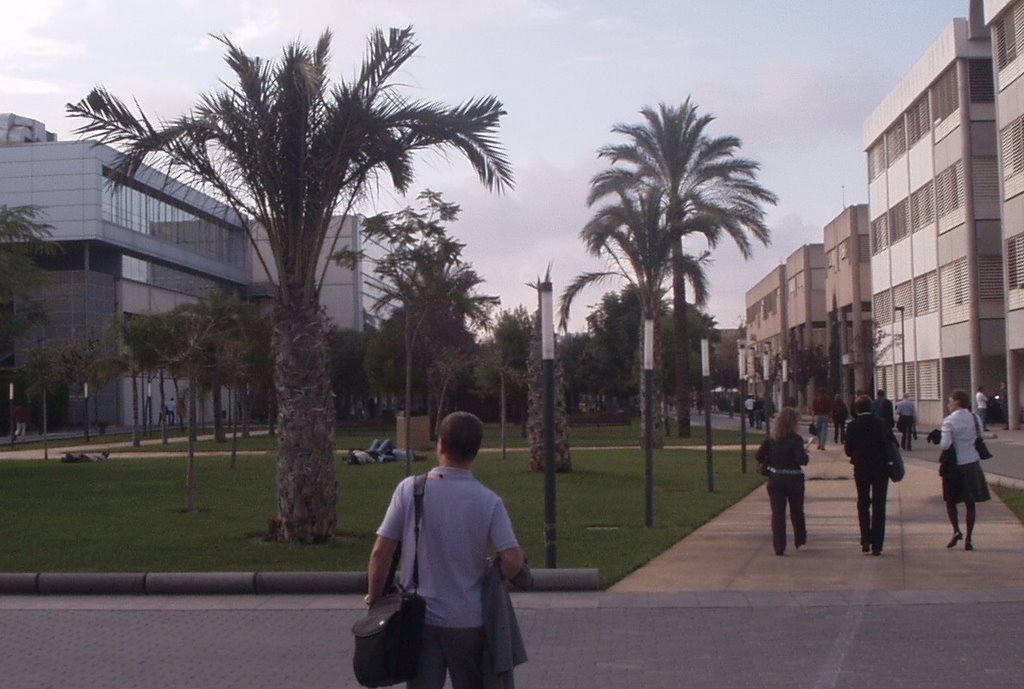
It's another cloudless warm day in Valencia, and we about to leave our hotel for Universidad Politecnica de Valencia for the second and final day of the Crafts in the EU conference. Above we see Chris McIntyre, Dean of the Faculty of Art and Design at the University of Hertfordshire, striding across the palm tree lined campus.

Today we have two main themes - new relation models and the role of new technologies - which should prove interesting. But don't just take my word for it. As I reported in my post below, there is a live webcast from the conference. Apparently you may need to give it a minute or so for the video streaming to start. Check out the conference programme, and join us today in Valencia!

09 November 2006

Hola!


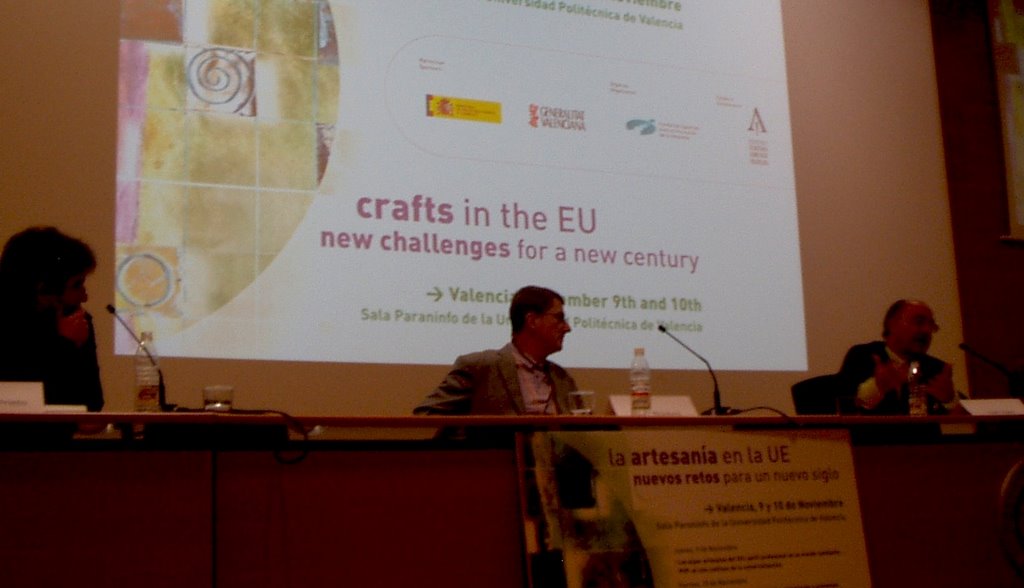
A quarry worker, a maker of hand-made luxury ice cream, a tailor, and a plumber who made ceremonial swords - these were just four of the people who took the floor in the first plenary session of Crafts in the EU - New Challenges for a New Century.

Today the Craft Research blog is reporting from Valencia, Spain at the end of the first day of this pan-European conference on the future of craft in Europe. I am speaking tomorrow afternoon, towards the end of this two day event organised by Fundacion Espanola para la Innovacion de la Artesania. The organisers are to be congratulated on pulling together speakers from eleven different EU countries, all covering a range of engaging issues. But most particularly they are to be commended in succeeding on what so often alludes us in the UK - attracting practitioners from the full range of craft practices: art-craft makers through to artesans.

This seemingly eclectic mix reflects the different cultural and economic conception of "the crafts" in the south of Europe, compared with the north - itself reflecting different economic structures. It makes for some spirited exchanges, and brings home the rich cultural diversity of Europe.

Spain is at a turning point in the development of higher education and - in particular - provision for art, design and craft. This conference is helping to inform that debate, and to place it in the context of perspectives and experiences from across the EU.

The morning started on a postitive note, with a government spokesperson arguing that while craft is not properly considered in Spain, there is an urgent need to recover the craft industry's reputation, to revalue skills and embrace new business strategies. All well and good. But then the following speaker claimed that "craftsmanship needs to be understood in terms of heritage".

There is a tension in the conference (a healthy tension) between a heritage/tourist development conception of craft, and a more future-focussed consumer-savvy view. In part this cuts as a north-south divide - but that would be to overly simplify some complex issues. There are some views expressed worth taking issue with, while others make postivie points with exceptional eloquence. The conference chair - Professor Jesus-Angel Prieto - in introducing the morning's main themes said "hands generate thought - they are a form of thought".

My personal highlight of the day was Rory O'Connor of marketing consultancy True Potential in Ireland. He presented a market analysis of craft in Ireland and the market oppportunities facing practitioners. There was a clarity in the analysis and sense of future direction that was refreshing. "Craft makers," said Rory "don't provide the stories; they don't make the offer". Pointing out that the craft sector effectively competes both with low cost producers in the far east and large multinationals, he set out the challenges - but, importantly, suggested economic ways forward for the sector.

This is a conference on policy and strategies for the crafts, and as such it is very welcome and timely. Comments from some of the speakers - and indeed from many on the floor - suggest that for significant sectors of the 'craft industry' there is no sustainable future unless radical action is taken to provide new business models, marketing strategies, and professional development. However, evidence from Germany, Finland, the UK and Spain itself is suggesting strategies that may have wider application across the EU. So, let us see how the discussions go tomorrow.

Now apparently there is a live webcast of the conference somewhere. My task this evening is to track down the URL for it. Watch this psace.

08 November 2006

craft research

Tina, on the Craft Scotland forum says "The word craft is misused, misunderstood and misplaced. It is used in ways that diminish its credibility. It is vitally important we reclaim the word craft so it is understood and people will buy it, galleries will want to exhibit it and the media will want to write about it. How can we stop the word craft being misused and misunderstood?" http://www.craftscotland.org/HaveYourSay.htm Some interesting replies have been given in response. Have a look. Perhapse we could look at it here too.

06 November 2006

passing comment

A craftsperson said, "The most attractive thing about craft is the sharing of knowledge" That passing comment got me thinking.
What really makes craft attractive? Where is the beauty in Craft? Is it in the sharing of knowledge? Is it in the finished artifact that reflects the craftsperson's personal vision? But wouldn't this then mean that the beauty of craft is in the entire process, person and product combined? What do you think?

25 October 2006

Another Houston Blog

An addition to our list of Blogs reporting on the 'Shaping the Future of Craft' conference. David Richardson leads Furniture Society - After Hours : thoughts and ideas related to studio furniture, craft, and art.

craft research

craft research
A remark by one of the delegates at the houston conference intrigued me. She was referring to Norman Kennedy a weaver/spinner origionally from Aberdeen, now living in the USA, http://www.nea.gov/honors/heritage/Heritage03/Kennedy.html and said, 'Of course he is a National Treasure now.' I wasn't aware that America, like Japan, had living 'National Treasures'. Isn't it wonderful that a Scottish Craftsperson is an American National Treasure!

"Japan’s living national treasuresScholars have long recognized the intangibility of culture. In the 18th and 19th centuries philologists, folklorists and others tried to document the world’s oral traditions. Yet the term “intangible cultural heritage” is relatively recent. In 1950, Japan initiated a living national treasures programme to recognize the great skills of masters of the traditional arts.Similar programmes began in Korea, the Philippines, Thailand, the United States and France. Intangible heritage is seen as an asset or resource to be protected, appreciated, utilized and managed–an idea traceable back to the Meiji period". http://www.unesco.org/courier/2001_09/uk/culture.htm
Does the UK honour people like this? Especially in the area of 'great skill in the traditional arts'? One would presume that craftspeople would be among these honoured people???